
A Natural Tree vs. A Digital Tree
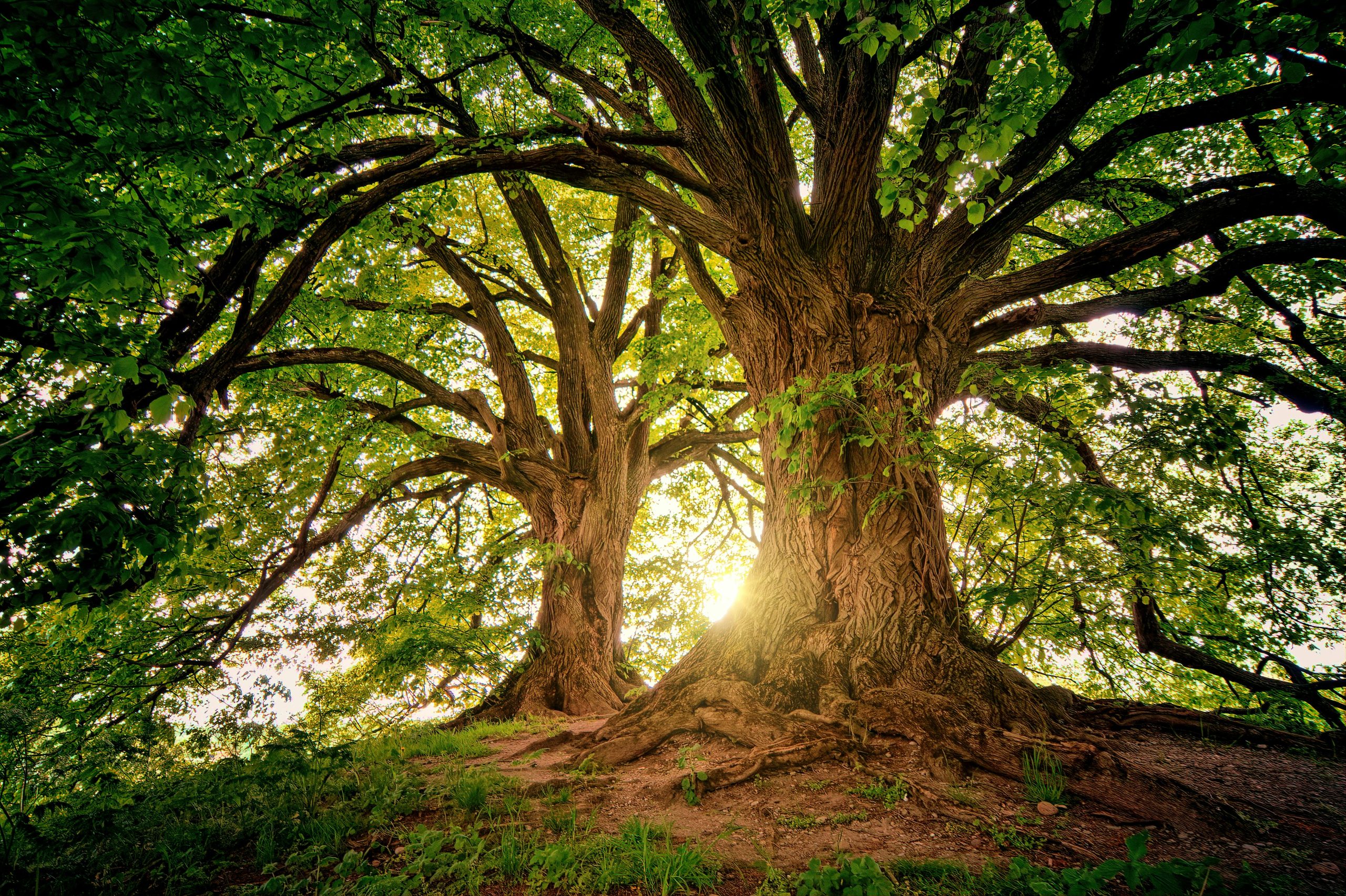
The digital representation of a tree and the “natural” tree differ significantly in their fundamental nature, leading to both gains and losses when we move from the physical to the virtual.
The “Natural” Tree
A living tree is a complex biological entity. It possesses:
- Physicality: It occupies three-dimensional space, has mass, a specific texture (bark, leaves), and interacts physically with its environment (wind, rain, soil).
- Biological Processes: It grows, photosynthesizes, respires, reproduces, and responds to its surroundings through complex chemical and biological mechanisms.
- Uniqueness: Each tree is genetically distinct and shaped by its unique history and environment, resulting in variations in form, health, and age.
- Dynamic Nature: It changes over time, through seasonal cycles, growth, damage, and decay.
- Sensory Qualities: It can be experienced through multiple senses: sight, touch (texture, temperature), smell (sap, leaves), and even sound (rustling leaves, creaking branches).
- Ecological Role: It plays a vital role in its ecosystem, providing habitat, regulating water flow, sequestering carbon, and contributing to nutrient cycles.
The Digital Representation of a Tree
A digital tree is an abstraction, a model created using computer software and data. It is:
- Mathematical and Algorithmic: It is defined by numerical data, geometric algorithms, and rules that dictate its form and behavior.
- Visual (Primarily): While data can represent other aspects, the most common digital representation is a visual model displayed on a screen or in a virtual environment.
- Reproducible and Modifiable: Digital trees can be easily copied, scaled, rotated, and altered in ways impossible for a natural tree.
- Data-Driven: Digital representations can incorporate various data, such as species, age, location, and environmental conditions, to influence their appearance and simulated behavior.
- Abstracted: It simplifies the immense complexity of a natural tree, focusing on specific aspects relevant to its intended use (e.g., visual appearance for a game, structural integrity for engineering simulations).
What is Gained in Digital Representation?
- Accessibility and Visualization: Digital trees can be viewed and manipulated from anywhere, regardless of the physical location of a real tree. They can also be visualized in ways that are impossible with a natural tree (e.g., showing internal structures, growth over time-lapse).
- Control and Customization: Digital models offer complete control over the tree’s appearance, allowing for stylized or scientifically accurate representations. Variations can be created easily.
- Simulation and Analysis: Digital trees can be used in simulations to study various phenomena, such as wind resistance, light interception, or the spread of disease, in a controlled and repeatable manner.
- Data Integration: Digital models can be linked to vast amounts of data, providing contextual information and enabling data-driven visualizations.
- Scalability and Efficiency: Large numbers of digital trees can be created and managed efficiently, which is crucial for applications like virtual forests or urban planning.
- Non-Destructive Analysis: Properties of a digital tree can be analyzed without causing any harm to a real tree.
What is Lost in Digital Representation?
- Biological Complexity: The intricate biological processes, the unique genetic makeup, and the subtle responses of a living tree to its environment are vastly simplified or absent in digital models.
- Sensory Experience: The feel of the bark, the smell of the leaves, the sound of the wind through its branches – the rich sensory experience of a natural tree is lost in a purely visual digital representation.
- Dynamic and Emergent Behavior: While simulations can model some aspects of growth and interaction, the unpredictable and emergent behaviors of a living tree in a complex ecosystem are difficult to fully capture.
- Ecological Context: The digital representation often isolates the tree from its surrounding ecological web, losing the crucial interactions with other plants, animals, fungi, and the soil.
- Intrinsic Value: A digital tree lacks the inherent biological and ecological value of a living organism. It does not contribute to the environment in the same fundamental way.
- The “Aura” of Nature: There is an intangible quality, a sense of connection to the natural world, that is experienced when interacting with a real tree that is absent in its digital counterpart.
In essence, the digital representation of a tree offers powerful tools for visualization, analysis, and manipulation, allowing us to understand and utilize aspects of trees in new ways. However, it necessarily sacrifices the profound biological complexity, the rich sensory experience, and the vital ecological role of the natural object. The choice between using a digital representation and interacting with a natural tree depends entirely on the specific purpose and the aspects of the tree that are most relevant to that purpose.
This post was created with Google’s Gemini AI.